
Marshall County Court Records After Arrest
A Marshall County jail arrest and a Marshall County court record are related, but they are not the same thing. The jail roster confirms custody, held-for agency, arrest date, and public hold reasons when available. The court record begins when a complaint or case is filed in Iowa district court. That court file may show the case number, party name, charges, filings, hearings, disposition, financial obligations, and payment status.
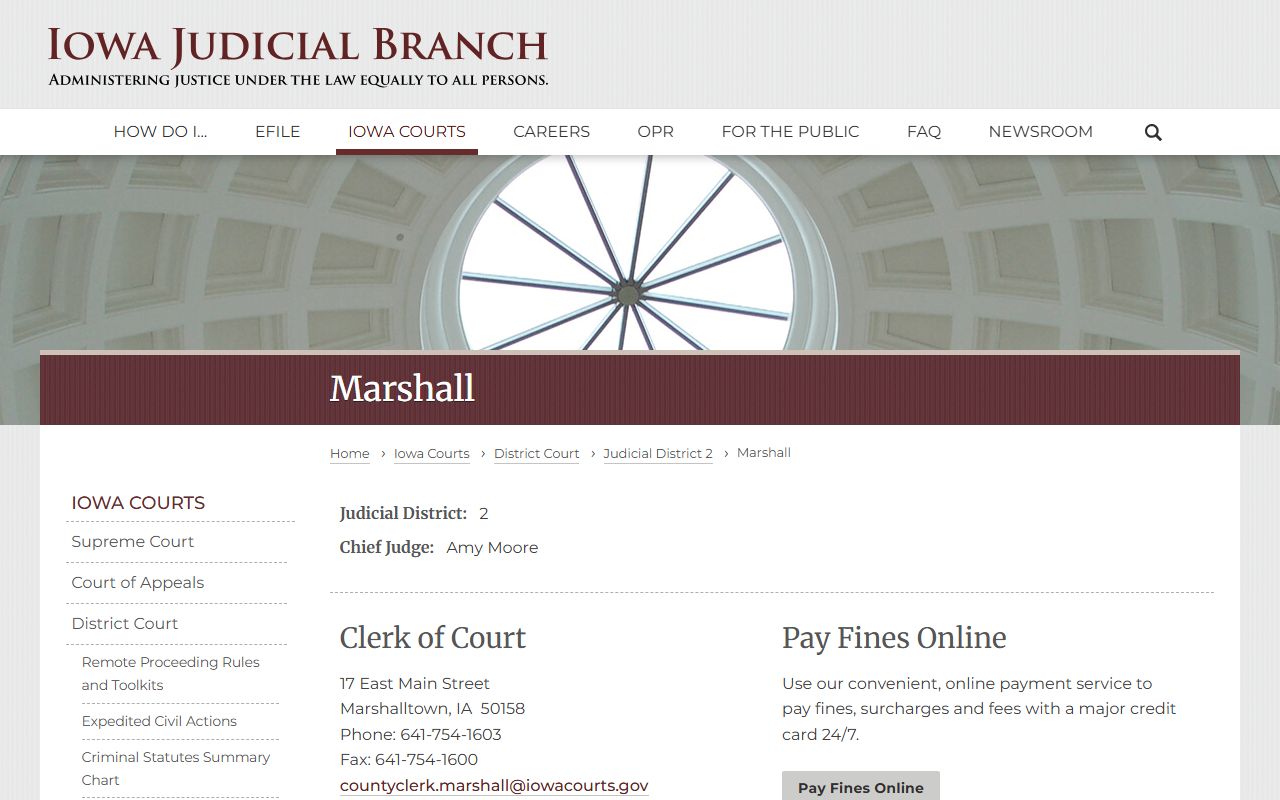
Marshall County is in Iowa Judicial District 2. The local Clerk of Court is the court-records office for district court files, while the Marshall County Attorney prosecutes county criminal cases. The sheriff's office can answer jail and custody questions, but it does not replace the court file. For current custody, use the Marshall County jail inmate records page. For booking photos, use the roster and the local mugshot rules.
Find Marshall County Court Records
The online case-search path is Iowa Courts Online, linked from Iowa Judicial Branch sources. It is the statewide court entry point for case lookup. Use it after a jail arrest when the question is about charges filed in court, case status, hearings, disposition, or financial obligations. If a person was just booked, the case may not appear until the charging paperwork reaches the court system.
- Search Iowa Courts Online by party name when no case number is known.
- Compare the court county, case type, and filing date to the jail arrest date.
- Open the matching case to review charges, hearings, filings, and disposition fields.
- Use the clerk for records questions and the jail for custody, housing, bond, or release status.
- Check Iowa Offender Search after sentencing if the person moves from jail to state custody.
The official court directory captured for the project shows the local court contacts. The Iowa Judicial Branch Marshall County court page is the source for clerk, scheduling, and district court routing.
Booking to Court Record
The arrest-to-court path usually starts with booking at Marshall County Jail. A jail record may show the arrest date, agency, and hold reasons. The formal court record follows when the prosecutor files a complaint or another charging document. Iowa Code Chapter 804 supplies the initial appearance framework after warrant and warrantless arrests, including appearance before a magistrate without unnecessary delay.
Bond can appear in more than one place. A roster hold reason may show bond text for a custody hold. Iowa Judicial Branch maintains a Uniform Bond Schedule for statewide context. The clerk and court file are the better sources for court debt, fines, and payment status, while the jail is the practical source for release status and custody logistics.
Note: A jail hold reason is not a conviction; read the court disposition before treating a charge as final.
Marshall County Charging Records
Charging documents explain why a criminal case exists after an arrest. The research did not capture sample Marshall County documents, so the table uses standard Iowa court concepts and keeps the language general. The case file, not the jail roster, is where the filed charging record and later amendments should be checked.
| Document | What it does | Where to check |
|---|---|---|
| Complaint | Starts many criminal cases by stating alleged facts and charges. | Iowa Courts Online or clerk record. |
| Trial information | Iowa felony charging document filed by the prosecutor after approval. | Court case file. |
| Indictment | Grand-jury charging document, less common than complaint or trial information. | Court case file. |
Marshall County Charge Status
A case can change several times after an arrest. A charge may be filed, amended, dismissed, pled, tried, deferred, or sentenced. A roster entry may still show a hold reason even when the court file has more current detail. The court record is the better source for what happened procedurally after filing.
| Status | Meaning | Why it matters |
|---|---|---|
| Pending | The case is open and not resolved. | Hearings, bond, or conditions may still be active. |
| Amended | The charge text or level changed. | Do not rely on the original arrest wording alone. |
| Dismissed | The court ended that charge without conviction. | Records may still exist unless sealed or expunged by law. |
| Deferred | A plea or judgment path may avoid conviction if conditions are met. | Read the final court entry carefully. |
| Convicted | The court entered a conviction. | Sentencing and DOC transfer may follow. |
Charges Versus Convictions
Court records after a jail arrest can include allegations long before a final outcome. The distinction matters for accuracy, employment issues, housing questions, and personal safety concerns. A charge states what the government alleges. A conviction is a final court outcome after plea, trial, or other adjudication.
| Term | Plain meaning | Best source |
|---|---|---|
| Arrest | Law enforcement took the person into custody. | Jail roster and sheriff record. |
| Charge | The prosecutor or complaint alleges an offense. | Court case file. |
| Conviction | The court entered a guilty outcome. | Disposition or judgment entry. |
| Sentence | The court imposed jail, prison, probation, fine, or other terms. | Sentencing order and DOC record if transferred. |
Marshall County Court Contacts
The local court and prosecutor contacts are separate from the jail. The Clerk of Court manages district court records and payment processing. The County Attorney prosecutes Marshall County criminal cases. The jail answers custody questions, but court filings should be checked with Iowa Courts Online or the clerk.
Marshall County Clerk of Court
17 East Main Street
Marshalltown, IA 50158
641-754-1603
Fax: 641-754-1600
Marshall County Attorney
County attorney category in county directory
Marshall County, Iowa
641-754-6314
Used in sheriff FAQ for payment-plan routing after fines are due.
Warrants After Marshall County Arrest
No official Marshall County public warrant search database was located in the sheriff sources. The sheriff site has a Most Wanted resource, but that is not a complete warrant index. If a person is already in custody, the roster hold-reasons field may show warrant-related text. If the question is whether a warrant exists before arrest, call the sheriff's office or dispatch rather than relying only on the roster.
Iowa Courts Online may show warrant-related entries after a case exists, but it is not guaranteed to be a real-time warrant lookup. A person can also be held in Marshall County for another county, another state, DOC, federal, or ICE matter, so the held-for agency field matters when the arrest did not originate locally.
Restricted Court Records After Arrest
Iowa public-record law gives access to many records, but it also recognizes confidential and restricted records. Juvenile matters, investigative files, privacy-sensitive material, and records covered by a court order may be treated differently from basic arrest and court docket information. Do not assume every arrest detail, mugshot, or investigative report is public through a roster or court search.
| Record status | What it means | Where to ask |
|---|---|---|
| Public | Available unless a specific law or order restricts it. | Roster, court search, clerk, or records division. |
| Confidential | Protected by law, such as some juvenile or investigative material. | Originating office or court. |
| Sealed | Closed by court order or rule from general public access. | Clerk of Court. |
| Expunged | Removed or limited under a legal process when eligibility applies. | Clerk or a licensed attorney. |
After Sentencing to DOC
Once a person moves from county jail to state custody, use Iowa Offender Search. DOC search covers sentenced prisoners and supervision records and is updated weekly. The court file still shows the case and sentence, while DOC shows the correctional custody side. Federal cases are different again: federal pretrial custody is tied to the U.S. Marshals Service, and sentenced federal inmates are searched through BOP.
Marshall County is served by federal pathways in Iowa, including the U.S. Marshals Service Southern District of Iowa. BOP records are for sentenced federal inmates, not local county bookings. ICE Online Detainee Locator is the separate path for immigration custody or CBP custody after more than 48 hours.